8 min read
On 13 November 2026, Prism Medical Products, LLC—a North Carolina-based home medical equipment and insurance coordination company, and a subsidiary of Henry Schein Inc.—disclosed that an unauthorised third party had broken into its network roughly four weeks earlier. Between 18 and 19 October 2026, attackers accessed and exfiltrated files containing some of the most sensitive personal information a company can hold. Approximately 1,326,066 individuals are affected.
Notifications were filed with state attorneys general in California, Vermont, Texas and Washington in the days that followed, and by the week of 19–20 November multiple class-action investigations had been announced. This breach is a pointed reminder that the risk to your medical data does not sit only with hospitals and GP surgeries. It sits with every organisation that touches your healthcare journey—including the company that arranged delivery of your CPAP machine or coordinated your insurance paperwork.
This article explains what was taken, why home-care suppliers hold such sensitive data in the first place, and what practical steps are worth taking if you think you may be among the 1.3 million affected.
What Was Compromised
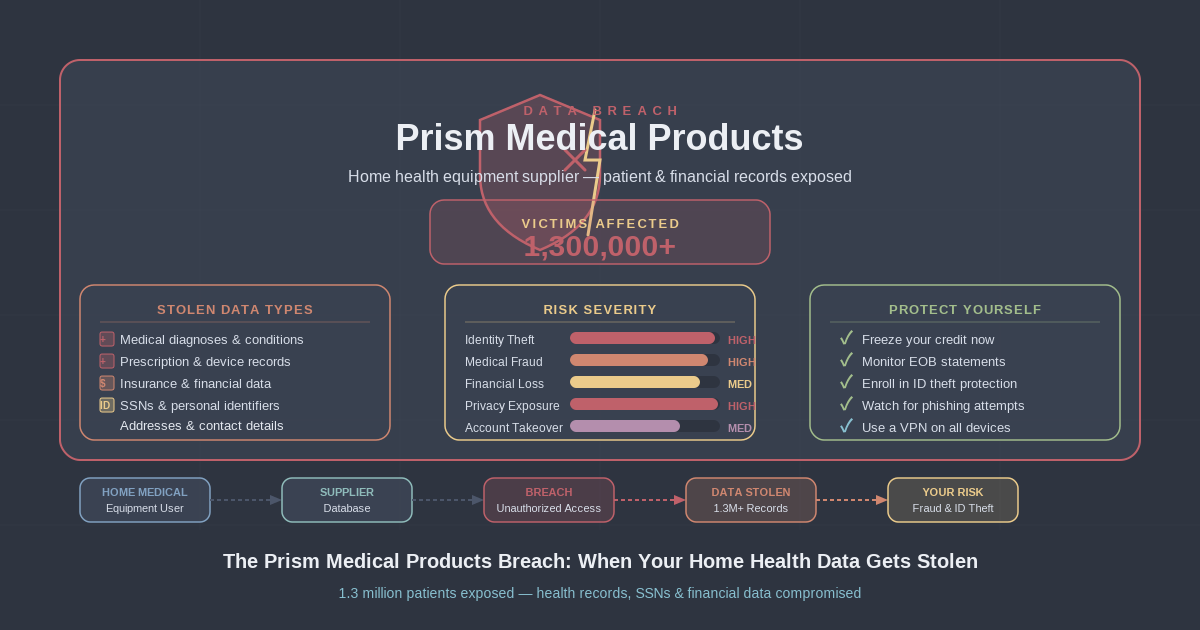
According to Prism's breach notifications, the categories of data potentially exposed include:
- Full names and home addresses
- Phone numbers and email addresses
- Social Security numbers
- Driver's licence numbers
- Medical and clinical information (diagnoses, treatment details)
- Health insurance details
- Financial account information
That is an unusually complete dossier. Most data breaches expose one or two categories—an email address here, a hashed password there. This breach potentially delivers the full picture: who you are, where you live, what conditions you have, how your care is funded, and the financial account details that underpin it all. For identity thieves and fraudsters, that combination is considerably more valuable than a leaked email list.
Why Home Medical Equipment Suppliers Hold This Much Data
It is worth pausing on why a supplier of home medical equipment was holding Social Security numbers and clinical diagnoses at all. The answer lies in how home healthcare is funded in the United States.
When a patient is discharged from hospital with ongoing needs—oxygen concentrators, hospital beds, wound care supplies, mobility equipment—their insurer or Medicare/Medicaid programme typically covers the cost. The supplier invoicing that insurer must demonstrate medical necessity, which means holding clinical documentation. They must also verify the patient's identity and coverage, which involves Social Security numbers and insurance records. Financial account details may be collected for co-payment processing.
In other words, Prism held this data because the American healthcare financing system required it to. That is not an excuse for a breach—it is an explanation of the structural reality that makes healthcare-adjacent companies such attractive targets. They accumulate the same richness of data as a hospital, often without the same security investment or regulatory scrutiny.
The Gap Between Breach and Disclosure
The intrusion occurred on or around 18–19 October 2026. The first public disclosure came on 13 November—roughly 25 days later. Notifications to state attorneys general in California, Vermont, Texas and Washington followed over the next four days.
A gap of three to four weeks between discovery and notification is not unusual under current US breach notification law, but it is worth understanding what that delay means in practice. If your data was exfiltrated on 18 October, attackers had nearly a month before you could have known to freeze your credit, change passwords, or alert your bank. During that window, your Social Security number and financial details could have been traded, tested, or used.
This is not a criticism unique to Prism—it reflects the limits of current notification frameworks. But it does illustrate why waiting to be notified is a poor strategy for protecting yourself.
What Makes Health Data Breaches Particularly Damaging
Financial credentials can be cancelled and reissued. A stolen credit card number is an inconvenience. A stolen medical record is permanent.
Your diagnosis of a chronic condition, a mental health history, or a record of a past prescription cannot be changed once it is out. When that information reaches data brokers or bad actors, it can influence insurance applications, employment background checks, or simply be used as leverage. Medical identity theft—where someone uses your details to fraudulently claim healthcare services or prescription drugs—can corrupt your own medical records with someone else's history, creating errors that persist for years and potentially affect your future care.
Social Security numbers make this worse. Unlike a password, your SSN is not something you can rotate. Once it is associated with your clinical data and home address in a leaked dataset, the combination is essentially permanent in that dataset.
Steps Worth Taking If You May Be Affected
If you received home medical equipment or coordinated insurance through Prism Medical Products, or if you receive a notification letter from them, the following steps are practical and proportionate.
Freeze your credit
Contact the three major US credit bureaux—Equifax, Experian and TransUnion—and place a security freeze on your file. This is free, can be done online, and prevents new credit lines being opened in your name without your explicit involvement. It is the single most effective defence against identity theft using a compromised SSN.
Monitor your explanation of benefits statements
Review any statements from your insurer for services you did not receive. Medical identity theft often surfaces here first—a claim for equipment or treatment you have no knowledge of. Contact your insurer immediately if you spot anything unfamiliar.
Review your financial accounts
Given that financial account information was among the categories potentially exposed, check your bank and payment accounts for unusual activity. Consider setting up transaction alerts if your bank offers them.
Be alert to targeted phishing
Attackers who hold your name, address, phone number, email, diagnosis, and insurer can craft very convincing phishing messages. An email appearing to come from your insurance company, referencing your actual condition and policy details, is far more credible than a generic scam. Treat unsolicited contact—by email, phone, or post—with scepticism, even when it appears to know accurate details about you.
Consider an identity protection service
Prism may offer complimentary credit monitoring as part of its breach response—this is common practice. If they do, enrol, but understand its limitations: monitoring tells you after something has happened, not before. A credit freeze is more preventative.
The Broader Pattern: Supplier Risk in Healthcare
The Prism breach is part of a consistent pattern that has become more visible over the past several years. As hospitals and large insurers have improved their own security postures, attackers have increasingly targeted the extended supply chain: billing companies, equipment suppliers, claims processors, and software vendors. These organisations often handle data equivalent in sensitivity to the primary healthcare provider, but may not have the same resources or compliance requirements.
For individuals, this creates a problem that is difficult to manage directly. You choose your GP and your hospital; you rarely choose which supplier your insurer or discharge team uses. Your data moves through organisations you have never heard of, subject to contracts and security standards you have no visibility into.
What you can control is your response posture: keeping an eye on your credit and financial accounts, being cautious about unsolicited communications, and acting quickly when a breach notification arrives rather than filing it away.
What This Means for Digital Privacy More Broadly
Breaches like this one reinforce why reducing your overall digital footprint matters—not because it would have prevented Prism's network from being compromised, but because the value of stolen data depends partly on what else can be correlated with it.
When your name and home address from a healthcare breach can be cross-referenced with your browsing history, your online purchases, or your location data harvested from apps, the resulting profile becomes more detailed and more exploitable. Limiting what third parties can observe about you online is a reasonable and achievable step.
A VPN does not prevent a company you deal with from suffering a breach. What it does is limit the ambient data collection that makes breached records more useful to those who obtain them. If you are unfamiliar with what a VPN actually does, that is a reasonable starting point. For those who want to browse with less exposure, PremierVPN Protect, our free browser extension, is a low-friction starting point. For more comprehensive protection across your devices, PremierVPN's personal plans cover Windows, macOS, iOS, Android, and Linux, and operate under a strict no-logs policy.
Summary
The Prism Medical Products breach affected roughly 1.3 million people and exposed a category of data—clinical diagnoses, Social Security numbers, insurance records, financial details—that is both highly sensitive and extremely difficult to remediate once it is out. The intrusion happened on 18–19 October 2026; public disclosure came on 13 November. Class-action investigations were announced within days.
The practical lessons are straightforward: freeze your credit now if you think you may be affected, watch your insurance statements carefully, and treat any communication that claims to know your medical details with caution. More broadly, this breach illustrates that your health data moves through organisations you have little visibility into, which makes maintaining your own security hygiene—not waiting for notification letters—the more reliable strategy.