Set Up PremierVPN on Windows
Download, install, and connect in under 2 minutes. Supports Windows 10 and 11 on Intel/AMD (x64) and ARM64 devices.
System Requirements
Download the Installer
Head to our downloads page and grab the installer for your system:
Go to DownloadsStandard PCs (Intel / AMD)
Download PremierVPN-Setup-x64.msi
ARM64 Devices
Download PremierVPN-Setup-arm64.msi
Not sure which to choose? Most Windows PCs use the x64 version. If you have a Surface Pro X or a laptop with a Snapdragon / Qualcomm processor, use ARM64.
Run the Installer
Double-click the downloaded .msi file and follow the setup wizard. The default settings are recommended for most users.
The installer bundles everything — WireGuard, OpenVPN (with Wintun driver), OpenConnect, and the PremierVPN background service. No additional software is required.
Windows SmartScreen warning
If SmartScreen appears, click "More info" then "Run anyway" — this is normal for newly released software and will disappear as more users install the app.
Launch PremierVPN
Once installation completes, PremierVPN will be available from your Start menu. You can also find it in the system tray (bottom-right of your taskbar).
On first launch, the app performs a one-time cleanup — stopping leftover VPN tunnels, clearing stale firewall rules, and resetting DNS to ensure a clean state.
PremierVPN requires administrator privileges to manage VPN connections and the kill switch (Windows Filtering Platform). You may see a UAC prompt when launching — click Yes to allow it.
Sign In
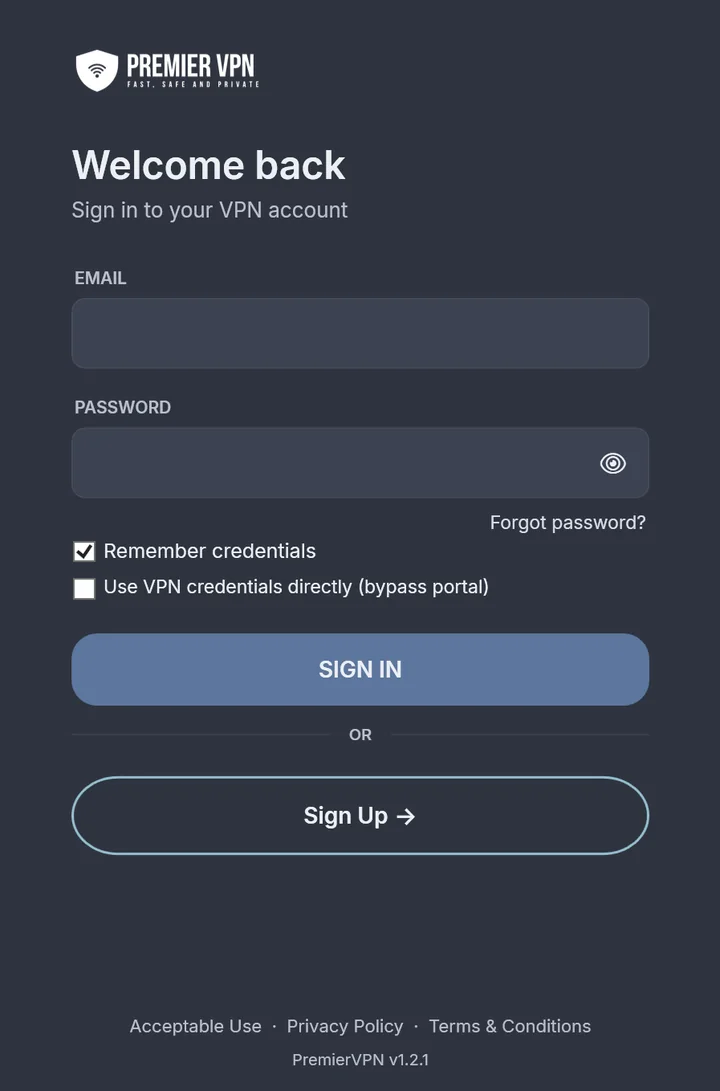
The login screen offers two ways to sign in:
Portal Login
DefaultSign in with your email and password — the same credentials you use at portal.premiervpn.net. The app automatically fetches your VPN credentials from the portal.
Supports 2FA (TOTP) if enabled on your account.
VPN Credentials
Tick "Use VPN credentials directly" on the login screen. Enter your VPN username and password from your Dashboard. Bypasses the portal entirely.
The label switches from "Email" to "Username" when active.
Which should I use?
Portal Login is recommended — just use your email and password. The VPN Credentials mode is useful for advanced users or when the portal is temporarily unreachable.
Tick "Remember credentials" to stay signed in. Your credentials are stored securely in Windows Credential Manager — you won't need to log in again unless you sign out or clear saved credentials in Settings.
Don't have an account? Sign up here or click Create Account in the app.
Connect to a Server
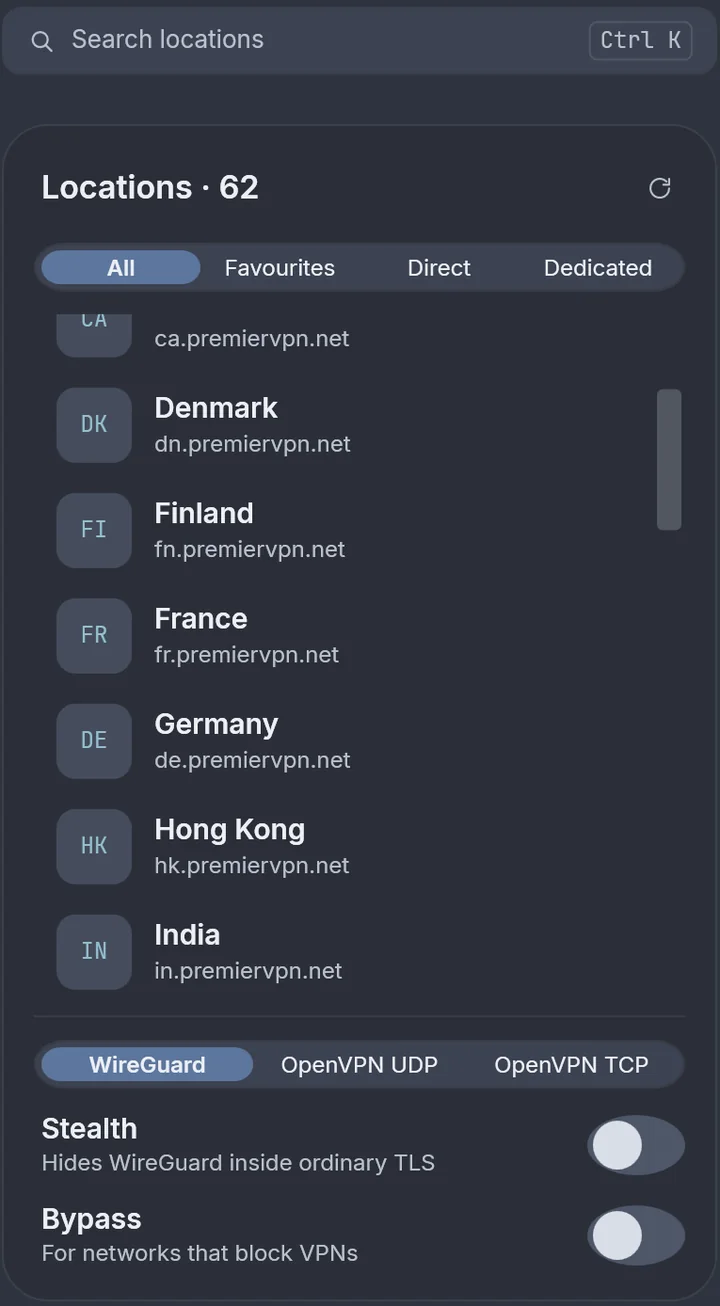
The server list is on the left side of the app, organised into tabs:
Use the search bar to find servers by country, or click the bookmark icon to save favourites for quick access.
Protocol Selector
At the bottom of the server list, four protocols are available:
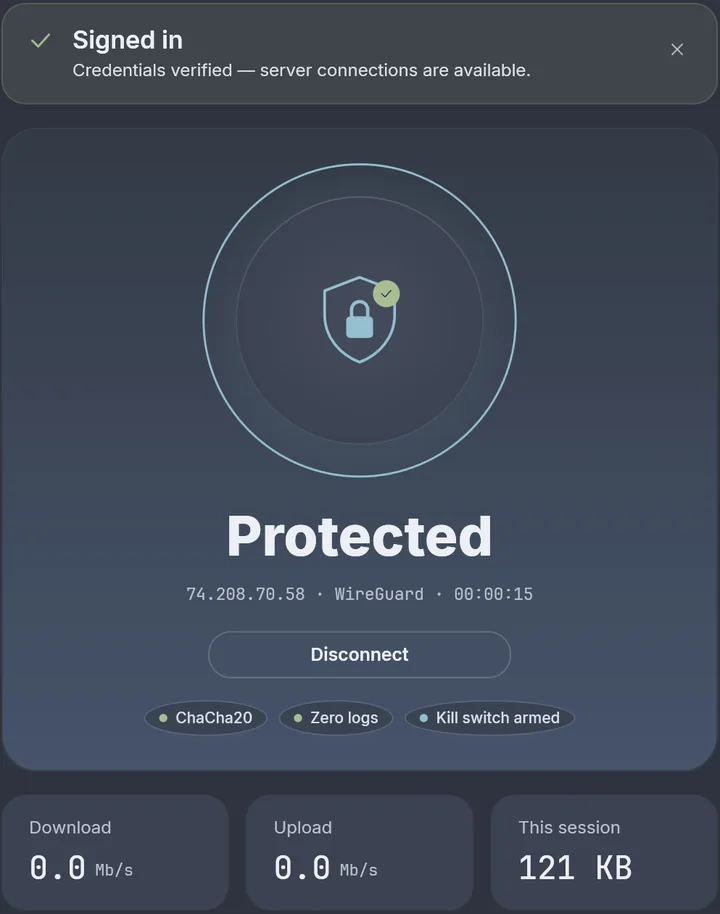
Select a server and click Connect. The shield icon animates while connecting and turns green once established. The connection details panel shows your VPN IP, protocol, cipher, handshake method, uptime, and live bandwidth usage.
WireGuard Stealth Mode
For networks that actively block VPN traffic
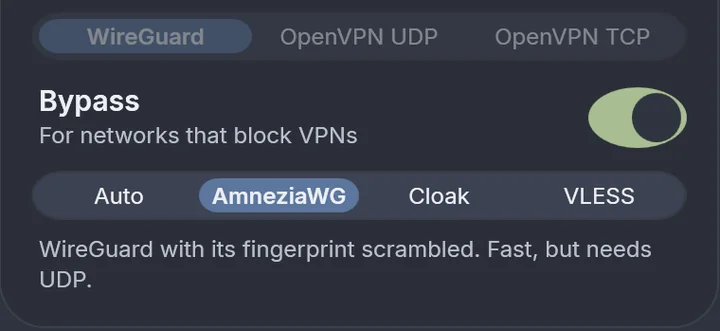
Stealth Mode wraps your WireGuard connection in a TLS tunnel on port 993, making it appear as standard encrypted email (IMAPS) traffic to network equipment. It's a toggle in Settings — no additional configuration required.
How to enable
Encryption
ChaCha20-Poly1305 inside TLS 1.2+
Port
TCP 993 (appears as IMAPS traffic)
Stealth vs OpenConnect: Stealth is the quickest option — just a toggle. If your network also blocks port 993, switch to OpenConnect (OC) in the protocol selector instead — it runs over pure HTTPS on port 443, which is virtually impossible to block without breaking all web traffic.
System Tray
PremierVPN runs in your system tray. Right-click for quick actions:
- Connection status, VPN IP & bandwidth
- Quick connect / disconnect
- Server selection by category
- Settings & Support
Double-click the tray icon to open the main window.
App Sections
Available from the left sidebar:
- Servers — map, server list & connect
- Account — subscription & VPN username
- Settings — kill switch, stealth, protocols
- Speed Test — download/upload test
- Logs — real-time log viewer with copy
- Support — email support form
Settings Overview
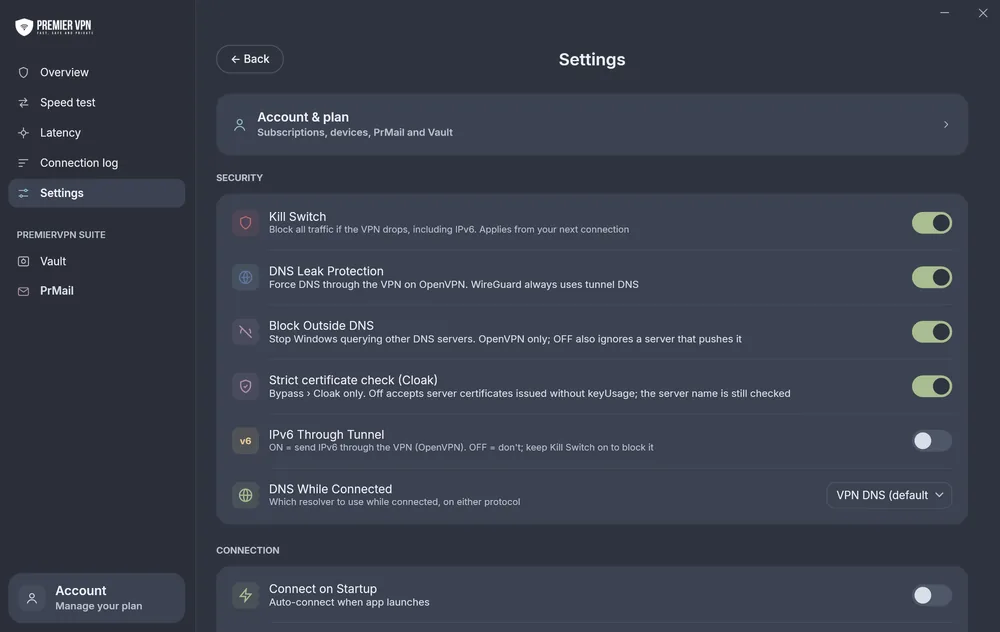
Access Settings via the gear icon in the left sidebar. Defaults are recommended for most users.
Security
| Kill Switch | ON | Blocks all internet if the VPN drops. Uses Windows Filtering Platform (WFP) — rules are cleaned up automatically on app restart. |
| DNS Leak Protection | ON | Routes all DNS queries through the VPN tunnel. |
| Block Outside DNS | ON | Prevents DNS queries from leaking outside the tunnel. |
| IPv6 Through Tunnel | OFF | IPv6 is blocked to prevent leaks. Enable only if you specifically need IPv6. |
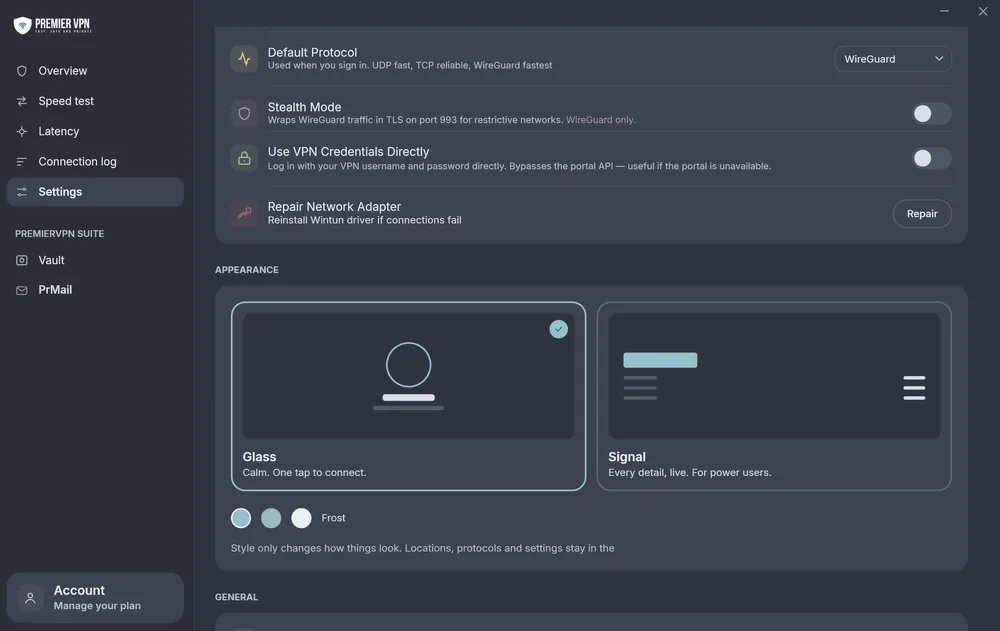
Connection
| Connect on Startup | Automatically connect to your last server when the app launches. |
| Auto Reconnect | Re-establish the connection automatically if the VPN drops. Disabled on authentication failure. |
| Default Protocol | Set which protocol to use by default (WireGuard recommended). |
| Stealth Mode | Wraps WireGuard in TLS on port 993 to bypass DPI and VPN blocks. |
| Use VPN Credentials Directly | Bypass portal login — use VPN username and password directly. |
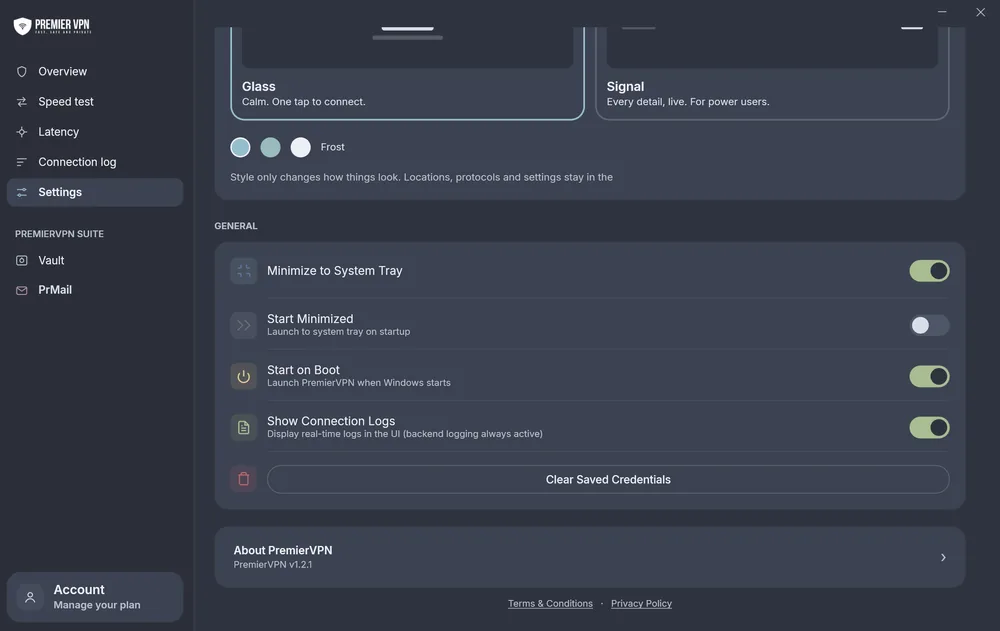
General
| Start on Boot | Launch PremierVPN at Windows startup via Task Scheduler (no UAC prompt). |
| Start Minimized | Launch to the system tray instead of showing the main window. |
| Minimize to Tray | Close button minimizes to tray instead of quitting the app. |
Troubleshooting
Try these in order:
- Switch protocol — try WG → UDP → TCP → OC
- Try a different server location
- Enable Stealth Mode in Settings and use WG
- Switch to OpenConnect (OC) — hardest to block
- Verify your internet works without the VPN
- Click "Repair Network Adapter" in Settings
This means the kill switch WFP rules are still active. Reconnect to the VPN then disconnect normally. If it persists, close and relaunch the app — it cleans up stale firewall rules and DNS overrides automatically on startup.
- Ensure you're running as Administrator (right-click → Run as administrator)
- Reinstall using the MSI installer
- App logs:
%LocalAppData%\PremierVPN\Logs\ - Service logs:
%ProgramData%\PremierVPN\Logs\
Portal Login: Use your portal email and password. The login label should say "Email". If you've forgotten your password, reset it here.
VPN Credentials: If "Use VPN credentials directly" is ticked, the label says "Username" and you need your VPN username/password from your Dashboard.
If you see "AUTH_FAILED" in the Logs screen during an OpenConnect or OpenVPN connection, your VPN (RADIUS) credentials are incorrect — check them on your Dashboard.
Try these in escalating order of stealth:
- OpenVPN TCP — uses port 443 via SSLH, sometimes enough
- WireGuard + Stealth Mode — enable Stealth in Settings, then use WG. Wraps traffic in TLS on port 993.
- OpenConnect (OC) — pure HTTPS on port 443. Indistinguishable from regular web browsing. Hardest protocol to detect or block.
This is normal for newly released software. Click "More info" then "Run anyway". The warning disappears automatically as more users install the app.
Visit the Support & Help Centre or open a support ticket. Include your Windows version, protocol, and any errors from the Logs screen (left sidebar → Logs → Copy).
Uninstalling
Open Windows Settings → Apps → Installed Apps, search for "PremierVPN", click the three dots (…) and select Uninstall. The installer stops the background service and removes all components automatically.
Settings and logs are stored in %LocalAppData%\PremierVPN\ and can be deleted manually if desired.
Ready to get started?
Download PremierVPN for Windows and protect your connection in minutes.