8 min read
Why Your Choice of Protocol Matters More Than You Think
Most people pick a VPN, install the app, and never give the underlying protocol a second thought. For browsing in the UK or a similarly open network, that approach is perfectly fine. But if you are travelling to or living in a country with heavy internet filtering — or if your workplace or university runs aggressive traffic inspection — the protocol you are using can be the difference between a working connection and no connection at all.
Governments and network administrators have grown considerably more sophisticated over the last decade. Simply encrypting your traffic is no longer enough. Modern firewalls use deep packet inspection (DPI) to identify VPN traffic by its fingerprint, even without decrypting it, and then block it at the network level. Understanding which protocols are resistant to this kind of analysis — and why — will help you stay connected wherever you happen to be.
How Deep Packet Inspection Blocks VPN Traffic
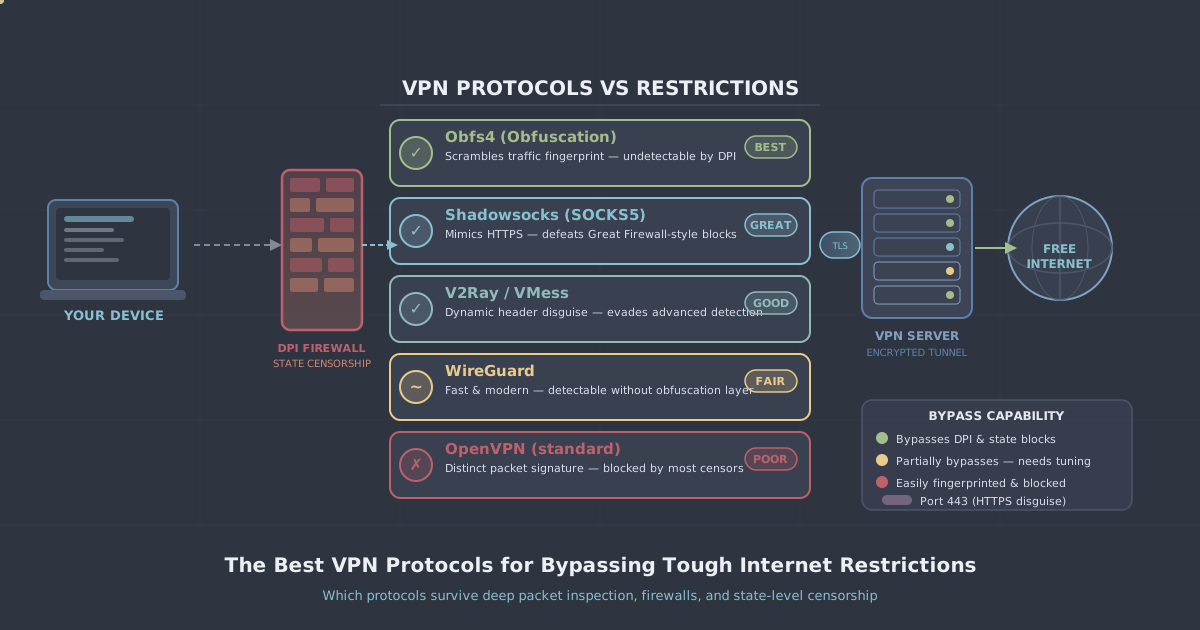
DPI works by examining the structure of data packets as they pass through a network gateway, looking for patterns that identify specific protocols. OpenVPN, for instance, has a recognisable handshake. WireGuard uses UDP on well-known ports. Even when the payload is encrypted, the metadata and connection behaviour can give the game away.
Once identified, the firewall can drop or throttle those packets without the user ever knowing why their VPN is failing to connect. This is common in countries such as China, Iran, and Russia, but also on some corporate and academic networks.
The protocols most vulnerable to DPI-based blocking are the ones that make no attempt to disguise what they are. The protocols best suited to restricted environments are those specifically designed to blend into normal HTTPS traffic or to make identification as difficult as possible.
The Main Protocols Compared
| Protocol | Speed | DPI Resistance | Best Use Case |
|---|---|---|---|
| WireGuard | Excellent | Low–Medium | Fast, reliable connections on open or lightly restricted networks |
| OpenVPN (TCP 443) | Good | Medium | General use; port 443 reduces some blocking |
| OpenVPN + obfuscation | Moderate | High | Networks using moderate DPI |
| VLESS + REALITY | Very Good | Very High | State-level censorship (China, Iran, Russia) |
WireGuard: Superb Performance, Limited Stealth
WireGuard is one of the most significant advances in VPN technology in recent years. Its codebase is lean, its cryptography is modern, and in most real-world tests it outperforms older protocols on both speed and battery efficiency. For the vast majority of users — those connecting from open networks in Europe, North America, or elsewhere — WireGuard is an excellent default choice.
However, WireGuard was not designed with censorship circumvention in mind. It communicates over UDP, which is frequently blocked in restricted environments, and its traffic pattern is relatively easy for DPI systems to fingerprint. If you are connecting from a country with active VPN blocking, a plain WireGuard connection is likely to fail or be throttled.
PremierVPN supports WireGuard across all of its apps, and also offers a Dedicated WireGuard Server for users who want the full performance advantage on networks where it works. If you need port-level control on top of WireGuard, the WireGuard with Port Forwarding option is worth considering.
OpenVPN: The Reliable Workhorse
OpenVPN has been around since 2001 and remains one of the most widely deployed VPN protocols in the world. It is highly configurable, well-audited, and supported on virtually every platform. When run over TCP on port 443 — the same port used by standard HTTPS web traffic — it becomes harder to block without also blocking legitimate encrypted web browsing, which most network operators are reluctant to do.
That said, OpenVPN's handshake is distinctive enough that advanced DPI systems can still identify it. On heavily filtered networks, a plain OpenVPN connection may still be blocked. The answer to this is obfuscation.
Obfuscation: Making VPN Traffic Look Like Nothing in Particular
Obfuscation layers — sometimes called traffic scrambling or steganographic wrappers — sit on top of a protocol and transform its traffic so that it resembles ordinary HTTPS or generates no recognisable pattern at all. Techniques vary, but the goal is consistent: deny the DPI system enough information to make a reliable identification.
OpenVPN with obfuscation is a practical solution for networks that use moderate DPI, such as some workplace firewalls and the censorship infrastructure found in certain countries. It is not infallible against the most sophisticated state-level systems, but it covers a large proportion of real-world restricted environments.
VLESS + REALITY: The Current Gold Standard for Censorship Circumvention
For users dealing with the most aggressive internet restrictions — particularly in China, Iran, and Russia — VLESS combined with the REALITY extension represents the most capable approach currently available.
VLESS is a lightweight proxy protocol, and REALITY is a TLS extension that takes traffic masking to a different level entirely. Rather than simply wrapping traffic in a TLS layer, REALITY uses the TLS fingerprint and certificate of a real, legitimate external website (a process called domain fronting at the TLS level). To a DPI system, the connection appears to be a genuine HTTPS session with a well-known service — there is nothing to identify as VPN traffic.
This approach is substantially more resistant to blocking than any obfuscated OpenVPN solution, and it has remained effective in environments where virtually every other protocol has been identified and blocked.
PremierVPN X is PremierVPN's dedicated app for VLESS + REALITY. It is available for both macOS and Windows and was built specifically for users in heavily censored regions.
- PremierVPN X for macOS — download and setup for Apple Mac users
- PremierVPN X for Windows — download and setup for Windows users
If you want to understand the technology in more depth before committing to it, the VLESS + REALITY protocol guide covers how it works and why it is particularly well suited to restricted environments.
How to Choose the Right Protocol for Your Situation
Open Networks (UK, Most of Europe, North America)
Use WireGuard. It is fast, modern, and reliable. There is no meaningful benefit to using a more complex protocol on an unrestricted network, and you will simply be adding overhead for no gain.
Workplace or University Networks
These environments vary considerably. Many block common VPN ports but allow port 443. Try OpenVPN over TCP on port 443 first. If that is blocked or unreliable, an obfuscated option is the next step. In particularly locked-down corporate environments, VLESS + REALITY may be the only reliable choice.
Countries with Moderate Filtering
Obfuscated OpenVPN is usually sufficient. These networks typically use commercially available DPI appliances with fixed protocol signatures, and obfuscation reliably circumvents them. Keep a fallback option available in case filtering is upgraded.
China, Iran, Russia, and Similar High-Restriction Environments
Use VLESS + REALITY via PremierVPN X. These countries operate sophisticated, actively maintained blocking systems. Plain WireGuard and plain OpenVPN are blocked reliably. Even obfuscated OpenVPN is increasingly challenged. VLESS + REALITY is the protocol specifically designed to address this level of restriction, and it is the one with the strongest track record in these environments.
For country-specific guidance, PremierVPN maintains dedicated resources for using a VPN in China and using a VPN in Iran.
A Note on Protocol Fallback
Network conditions change, and the filtering landscape in any given country can shift without notice. It is worth having more than one approach available. If your primary protocol stops working, you want to be able to switch quickly without having to research alternatives under pressure. Installing PremierVPN X alongside the standard PremierVPN app gives you that flexibility — two different technical approaches available on your machine whenever you need them.
Privacy Across All Protocols
Choosing a protocol that can bypass restrictions is only part of the picture. What happens to your data once the connection is established matters equally. PremierVPN operates a strict no-logs policy — no connection timestamps, no IP addresses, no traffic data. This applies regardless of which protocol you are using.
If you are unsure whether your connection is actually protecting your IP address, the IP leak test tool will confirm whether DNS requests and your real IP are properly hidden.
Summary
Selecting the right VPN protocol is not a matter of picking the most technically impressive option — it is about matching the protocol to the network environment you are actually dealing with. WireGuard is the right answer for most users on most networks. OpenVPN with obfuscation handles moderate restrictions well. And for the most demanding environments, VLESS + REALITY via PremierVPN X is the tool built specifically for the job.
If you are not yet a PremierVPN user and want to understand the broader context before getting started, the introduction to VPNs is a good place to begin.