8 min read
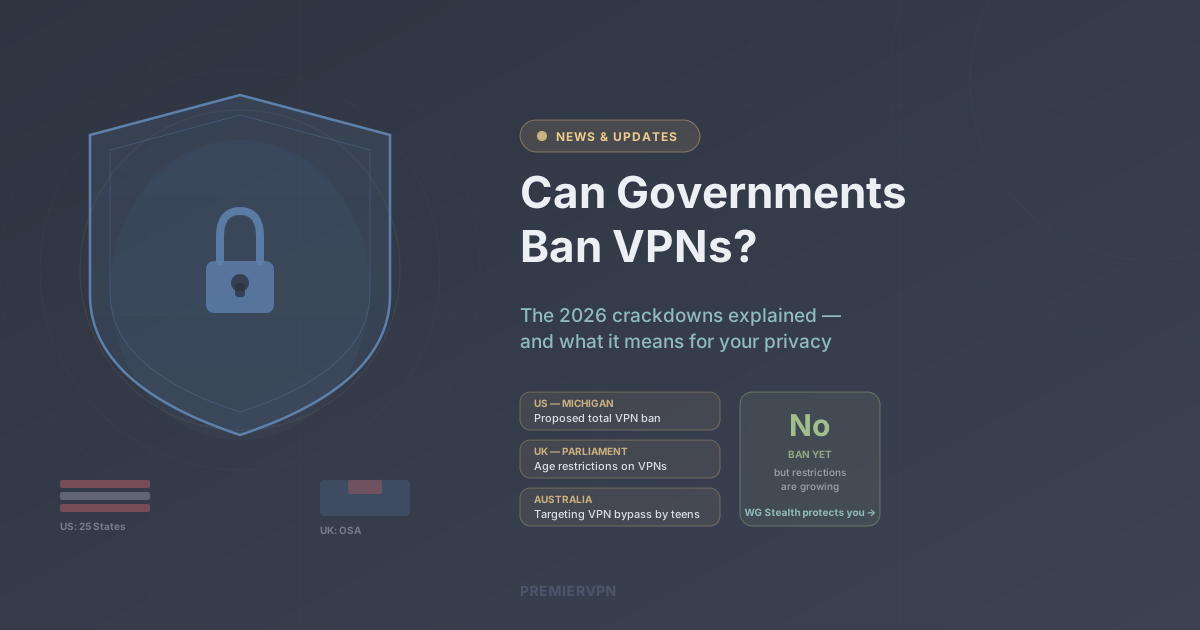
In September 2025, Michigan lawmakers proposed a bill that would have made VPNs illegal for general use. In Australia, government guidance on its social media ban for under-16s specifically called on platforms to stop teenagers using VPNs to bypass restrictions. In the UK, Members of Parliament debated whether VPNs should require age verification and called for an investigation into "the VPN issue."
No country in the Western world has banned VPNs yet. But the direction of travel is clear, and 2026 is shaping up to be one of the most consequential years for online privacy in recent memory.
What's Actually Happening
It's worth separating what governments are doing from what they're saying, because the rhetoric is moving faster than the legislation.
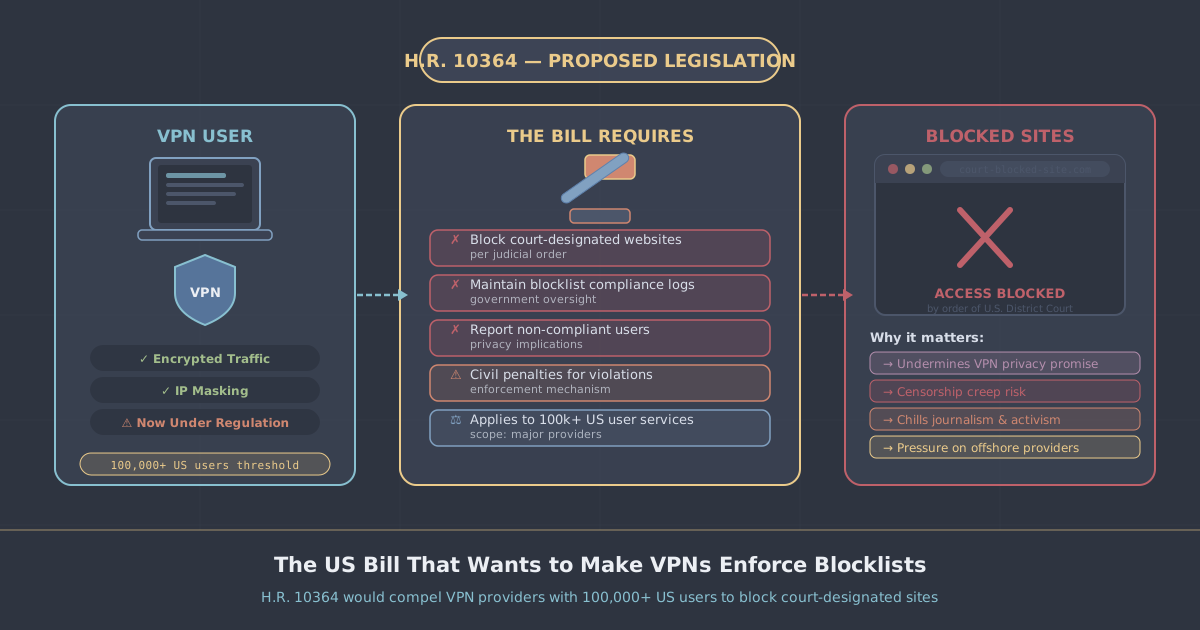
In the United States, the VPN-related proposals have so far been tied to specific contexts — primarily age verification for adult websites and social media restrictions for minors. No federal VPN ban has been proposed, and the Michigan bill was widely criticised and hasn't progressed. But 25 states have now passed age verification laws, and VPNs are explicitly mentioned as a workaround that legislators want to address.
In the United Kingdom, the Online Safety Act is the central piece of legislation. Age verification requirements are coming into force in stages throughout 2026. The government has acknowledged that VPNs make age verification harder to enforce, and has said it will look at the issue — though no specific VPN legislation has been introduced. Separately, the Online Safety Act gives Ofcom significant powers to require platforms to block content or services, which could theoretically extend to VPN providers in future.
In the European Union, the Digital Services Act and ongoing debates about "Chat Control" — legislation that would require messaging platforms to scan private messages — are the main pressure points. The VTI (VPN Trust Initiative) has noted that it expects "continued pressure on encryption, VPN services, and privacy-enhancing technologies, particularly through regulatory or policy frameworks that blur the line between lawful access and systemic weakening of security."
In authoritarian countries, the picture is more stark. Russia, China, Iran, Pakistan, and Myanmar have all intensified their efforts to block VPN traffic in recent years. Russia blocked or restricted hundreds of VPN services in 2024 and 2025. Iran regularly disrupts VPN connectivity during periods of civil unrest. These aren't new developments, but the technology being used to enforce the blocks is becoming more sophisticated.
Can a Government Actually Ban VPNs?
In an authoritarian country with control over its network infrastructure — yes, with significant effort. China's Great Firewall is the most advanced example: it uses deep packet inspection to identify and block VPN protocols in near real-time, requiring VPN providers to constantly update their technology to stay ahead.
In a democratic country with a relatively open internet architecture — it's technically and politically much harder. VPNs are used legitimately by millions of businesses for remote access, by journalists, by legal professionals, and by ordinary people. Banning them outright would cause enormous collateral damage to legitimate commerce and communications. It would also be effectively unenforceable without the kind of wholesale internet infrastructure changes that would themselves be politically toxic.
What's more likely in Western countries is incremental restriction: requirements for VPN providers to verify users' ages, pressure on app stores to remove certain VPN apps, or requirements to block access to certain content categories. Each of these is more politically achievable than an outright ban — and each erodes the utility and privacy of VPN services in different ways.
What This Means for You Right Now
The practical implications vary depending on where you are and what you use a VPN for. For most users in the UK, US, or EU, nothing changes immediately. VPNs remain entirely legal, and there's no imminent threat to your ability to use one.
What's worth paying attention to is the direction of change. The window in which VPNs are entirely unrestricted may be shorter than it once appeared. Using one now, understanding how it works, and choosing a provider with a strong technical foundation is sensible preparation.
WireGuard Stealth — Built for the Future
The most technically significant development in consumer VPNs over the last two years has been the emergence of stealth or obfuscated protocols — designed to make VPN traffic undetectable even to systems specifically looking for it.
PremierVPN's WireGuard Stealth protocol wraps WireGuard traffic so that it appears as ordinary HTTPS to any network monitoring system. It's available on all PremierVPN apps — Windows, macOS, iOS, and Android — and enables automatically on networks where standard VPN traffic is restricted.
For users in countries with active censorship, or for anyone concerned about the direction of travel in Western regulatory environments, WireGuard Stealth provides a meaningful level of additional resilience. And for regions where even stealth protocols can be challenged, PremierVPN X (VLESS + Reality) goes further still — confirmed working in China, Iran, and Russia where all standard VPN protocols are blocked.
The Bigger Picture
The pressure on VPNs reflects a broader tension that isn't going away: governments want more visibility and control over what happens on the internet within their borders, and a significant portion of their populations wants exactly the opposite. VPNs sit at the centre of that tension.
The technology to preserve privacy is advancing alongside the technology to undermine it. The outcome will depend not just on what tools are available, but on the political and legal battles being fought in parallel — in courts, in legislatures, and in public discourse.
What's clear is that 2026 is not the year to take your online privacy for granted.
Stay Protected with PremierVPN
WireGuard Stealth and VLESS + Reality — built to work even as restrictions tighten. No-logs policy, 25+ server locations, and apps for every device.
View Current Offer → Learn About VLESS + Reality →