9 min read
The phrase "independently audited" appears on a lot of VPN marketing pages. It sounds reassuring—a neutral third party has looked under the bonnet and confirmed everything is in order. But unless you know what auditors actually test, and what the scope of any given audit excludes, that phrase can give you more confidence than the evidence warrants.
This article breaks down what a VPN security audit is, what the different types cover, how to read the results critically, and what questions are worth asking before you place weight on an audit as part of your privacy decision.
Nothing here is meant to dismiss audits—they are genuinely useful. The goal is to help you understand them well enough to treat them as one piece of evidence rather than a final verdict.
The Basic Idea: What an Audit Is
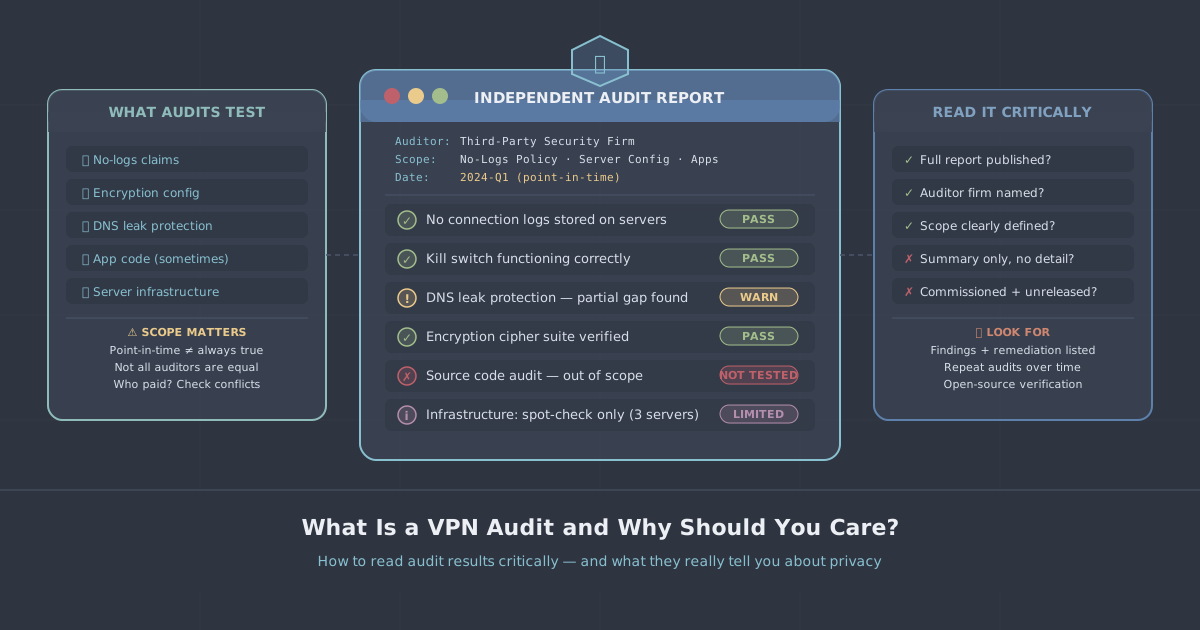
A VPN security audit is an engagement where an independent firm—usually a specialist cybersecurity company—is contracted to examine some part of a VPN product or service. The firm produces a report detailing what they looked at, what they found, and whether identified issues were resolved.
Audits are not a continuous process. They happen at a point in time, cover a defined scope, and reflect the state of a product during that window. Software is updated frequently, so an audit from eighteen months ago tells you about code that may have changed substantially since.
The auditing firm is typically paid by the VPN provider. That does not automatically make the findings unreliable—reputable security firms have professional reputations to protect—but it is a structural fact worth keeping in mind when weighing how findings are communicated.
Types of VPN Audit
Not all audits test the same things. The term covers several distinct types of engagement, and conflating them leads to misreading what any particular audit actually means.
No-Logs Policy Audits
These examine whether a VPN service's server infrastructure and operational practices are consistent with its stated no-logs policy. Auditors typically inspect server configurations, database schemas, log files (or the absence of them), and related system settings to confirm that user activity data is not being stored.
A no-logs audit is arguably the most commercially prominent type. It is also one of the most limited in technical scope—it confirms a configuration at a moment in time on the servers the auditors were given access to. It cannot confirm what happens on every server in every location, and it cannot confirm future behaviour.
Application Security Audits
These focus on the client applications—the software you install on your device. Auditors review the source code and/or the compiled binaries for security vulnerabilities: things like improper handling of credentials, weak cryptography implementations, insecure local storage, or flaws that could allow an attacker to interfere with the VPN connection.
A strong application audit gives you meaningful assurance about the software running on your machine. It is worth checking which platforms were covered. An audit of the Windows app says nothing about the iOS or Android client.
Infrastructure and Penetration Testing
Penetration testing involves auditors actively attempting to compromise systems—servers, APIs, management interfaces—to find vulnerabilities before attackers do. This is more adversarial in approach than a configuration review and can surface issues that passive inspection misses.
Infrastructure audits more broadly may cover how servers are provisioned, how administrative access is controlled, how encryption keys are managed, and whether network segmentation is in place to limit the blast radius of any breach.
Cryptographic Protocol Reviews
Some audits focus specifically on how a VPN implements cryptographic protocols—whether WireGuard or OpenVPN is configured correctly, whether cipher suites are current and appropriate, and whether there are any implementation errors that could weaken the encryption in practice even if the protocol itself is sound.
This matters because a protocol like WireGuard is well-designed and publicly scrutinised, but a poor implementation can undermine it. Protocol reviews examine the gap between the specification and what is actually running.
What Audits Cannot Tell You
Understanding the limits of an audit is at least as important as understanding what it covers.
- Scope constraints: Auditors can only examine what they are given access to. A no-logs audit covering three server locations does not speak to all server locations. This is not dishonesty—it is a practical limitation—but it should inform how much weight you place on the finding.
- Point-in-time validity: An audit is not a continuous certification. If code changes after the audit concludes, the audit no longer reflects the current state. Check the date and whether the provider has committed to repeat audits on a regular schedule.
- Legal and jurisdictional risk: No technical audit addresses what happens when a VPN provider receives a legally binding government order to log or disclose data. That is a legal and jurisdictional question, not a technical one. A UK-based provider operates under UK law; understanding that context matters independently of any audit result.
- Business continuity: An audit reflects the company as it existed during the engagement. Changes in ownership, staff, or business model after the audit are not captured.
- Supply chain: If a VPN provider uses third-party server infrastructure, the audit may not reach the underlying hardware or hosting environment. Management plane security at the hosting provider level is often out of scope.
How to Read an Audit Report
When a provider publishes an audit report—or a summary of one—there are specific things worth looking for rather than simply noting whether the outcome was described as positive.
- Who conducted it? The auditing firm's name and reputation matters. Established firms in the security industry have track records you can look into independently.
- What was the defined scope? Every audit report should state explicitly what was and was not examined. If this information is absent from the published summary, consider asking the provider for the full report or at minimum a detailed scope statement.
- What findings were reported? Audits that report zero findings are unusual. Honest engagements typically surface at least minor issues. A report claiming perfection deserves more scrutiny, not less. What matters is whether identified issues were categorised by severity and whether the provider addressed them.
- What was the remediation status? Good audit reports include a follow-up section confirming which findings were fixed, which were accepted as acceptable risk, and which remained open. A finding resolved before publication is not a red flag—it is normal practice.
- When was it conducted? Check the date. An audit conducted over two years ago on a product with frequent updates has limited relevance to the current codebase.
- Is the full report public? Summaries are useful but selective. Providers who publish the complete report demonstrate a greater commitment to transparency than those who publish only a highlights document.
What Else to Look For Beyond Audits
Audits are one signal among several. A privacy-conscious user evaluating a VPN service should consider them alongside other factors rather than treating them as sufficient on their own.
The provider's no-logs policy itself deserves reading in full. Policies vary considerably in what they claim not to collect. Some exclude connection timestamps, some retain them, and the wording can be technical. A no-logs audit means little if the underlying policy permits retention of data you consider sensitive.
Jurisdiction matters. A provider based in a country with mandatory data retention laws, or that is part of intelligence-sharing arrangements, operates under different legal constraints regardless of what any audit says about its technical configuration.
Protocol transparency is relevant. Open protocols like WireGuard and OpenVPN can be examined by the broader security community. Proprietary protocols cannot, which means you are reliant entirely on whatever testing the provider commissions. PremierVPN uses WireGuard as its default protocol, along with OpenVPN and—via PremierVPN X—VLESS+REALITY for restrictive network environments. Using open, well-scrutinised protocols reduces the portion of trust that must rest on the provider alone.
You can also do some basic verification yourself. An IP leak test after connecting to a VPN will tell you whether DNS queries and your real IP address are being exposed, regardless of what any audit claims. It is not a substitute for a professional audit, but it is a practical sanity check you can run in minutes.
A Practical Summary
VPN audits are a useful accountability mechanism, and providers who commission and publish them are doing something meaningful. But the phrase "independently audited" on its own tells you almost nothing. The value of any audit depends entirely on its scope, the credibility of the firm that conducted it, the transparency with which findings were reported, and how recently it was carried out.
When you encounter an audit claim, ask: what exactly was tested, by whom, when, and is the full report available? If a provider cannot or will not answer those questions clearly, the audit offers less assurance than its marketing suggests. If they can answer them well, you have a genuinely useful piece of evidence to add to your overall assessment.
Combine audit results with an honest reading of the provider's privacy policy, an understanding of the legal jurisdiction they operate in, and—where possible—your own technical verification. That combination gives you a far more grounded picture than any single endorsement can.